Go-to-market strategy · Duke Engineering
building a gtm system
ROLE
GTM strategy, product launches, process design
scope
5 new programs, 25+ program portfolio
RESULT
Duke Engineering's first comprehensive GTM playbook

Duke Engineering was rapidly expanding its master's portfolio, but there was no established process for bringing new products to market. Each launch relied on the institutional knowledge of talented and experienced team members—knowledge that could be lost if a key person left.
Over four years, I led marketing strategy for bringing approximately five new master's programs to market. As the launches accumulated and the lessons learned piled up, I began to recognize the patterns and the opportunity to turn individual experience into an organizational system.
The visible aspects of a launch—from websites to campaigns, info sessions, and roll-up banners—are the end of the process, not the beginning.
Successful launches depended on answering a consistent set of strategic questions well before campaign activation:
➡ What problem does this offering solve? Who is it for? What's our value proposition, and what evidence supports it? What are the alternatives, and why should they choose us? How will we reach them, and how will we know what's working?
The specific answers changed from program to program, but the underlying questions did not. That meant the launch process itself could become repeatable without making the strategy formulaic.
I'll be honest: I started this project only planning to document the marketing aspects of a launch, but soon realized all the parts are deeply interconnected. The earlier that academics, operations, marketing, and admissions start working together, the better the end result will be.

the system
Connecting stakeholders through shared purpose and clear roles.
I synthesized lessons from five launches into Duke Engineering's first comprehensive go-to-market playbook. The goal wasn't to prescribe identical tactics for every program, but to establish the questions, decisions, inputs, responsibilities, and milestones that should guide every launch.
Key discovery: Future launches would benefit from formally naming a launch lead, a person responsible for overseeing the process and controlling scope, schedule, and resources. (My PMP cert at work!)
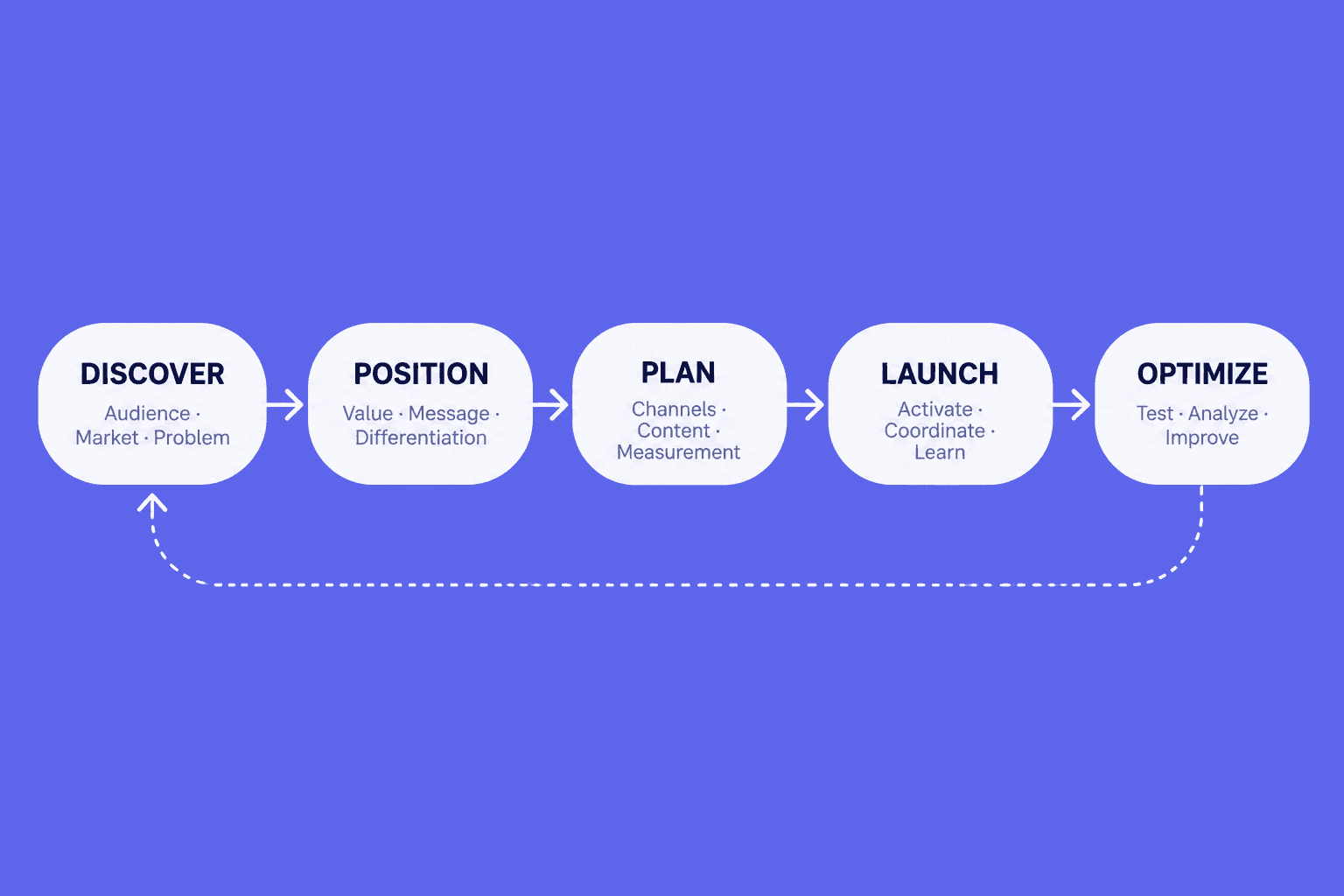
I developed the framework based on my experience leading the marketing and GTM workstream across approximately five program launches.
For each launch, I partnered with faculty and academic leadership as subject-matter experts while owning audience research, competitive analysis, positioning, messaging, channel strategy, and marketing activation.
I then stepped back from the individual launches to identify recurring patterns, document best practices, and create a system that future teams could use without rebuilding the process from scratch.
Execution
I could show you the entire playbook, but then I'd have to kill you. 😜
No, seriously, I have to exercise some discretion here, but the screenshot below presents the 30,000 foot view.
➡ Six phases
➡ Core questions to answer and outputs to create
➡ A "gate" at the end of each phase—go no further unless conditions are met

Results
5
new program launches informing the framework
25+
program portfolio supporting by a common GTM methodology
1st
comprehensive GTM playbook for Duke Engineering
The playbook turns knowledge accumulated across individual launches into a reusable organizational asset. It gives future teams a common language and structured process for moving from market opportunity to launch and optimization, reducing dependence on institutional memory and helping stakeholders address critical GTM questions earlier.
What I Learned
A playbook doesn't replace expertise; it enhances it.
We were doing ourselves a disservice by not having a clear, repeatable plan for launching products. We could get away with it because of the collective skill and experience of our team, but relying on that wasn't sustainable.
Besides, having clearly defined phases, roles, and objectives makes it easier for each of us to focus on doing what we're great at.
BONUS: I leveled up my AI-assisted workflow skills with this project. I had the AI interview me extensively about my launch experiences, fed it requirements and best practices, and used Codex to generate the first draft of the document. Then I read and validated every word, rewriting it substantially.
The knowledge took 4+ years to gain; I made the playbook from scratch in a day.